Research Summary
The terahertz (THz) frequency range (100 GHz to 10 THz), positioned between radio waves and light waves on the electromagnetic spectrum, holds promise for a wide range of applications including wireless communications, imaging, sensing, and medical technology. Especially, research and development are actively underway to utilize THz waves for wireless carrier frequencies as ultimately high-frequency radio waves for next-generation wireless communication systems (Beyond 5G; B5G). These systems, characterized by ultra-high speed, ultra-high capacity, ultra-low latency, and ultra-low power consumption, serve as the foundational technology for realizing “Society 5.0”—a sustainable, ultra-smart future society where virtual and real spaces are highly integrated.
Realizing the next-generation B5G wireless communication systems requires device and system technologies capable of freely utilizing “ultra-broadband” electromagnetic waves spanning from optical to terahertz frequencies, and from microwaves to baseband. This research laboratory specifically aims to create sub-THz/THz-band semiconductor devices and optical-wireless-convergence devices based on novel physics, principles, and materials.
We are currently working on the following research themes.
Research Theme #1: THz Plasmonic Detectors
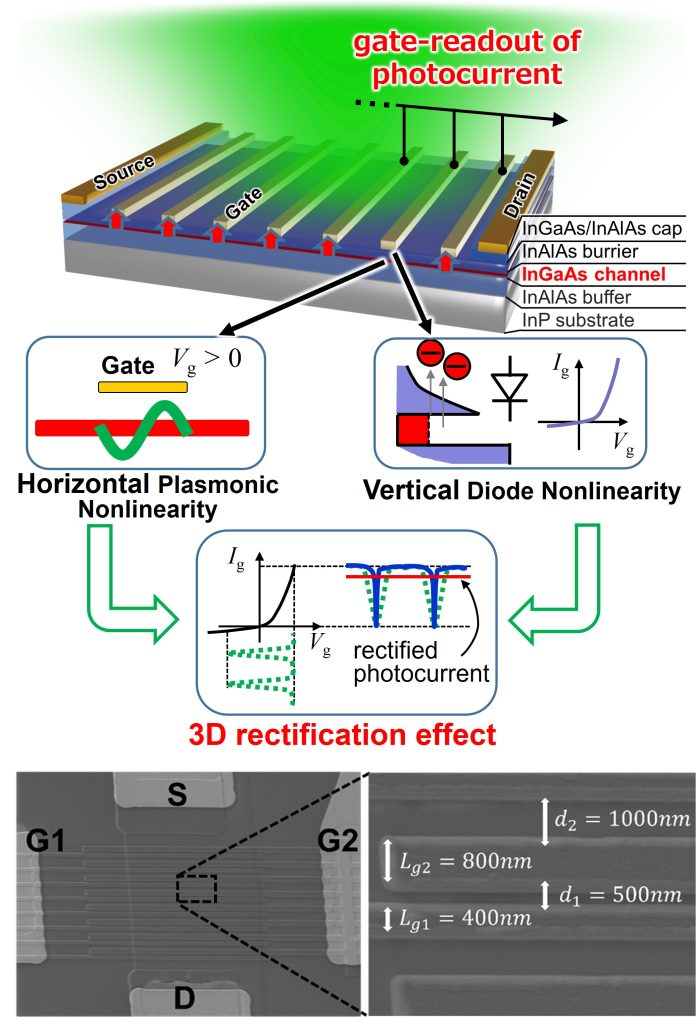
A charged oscillation quantum, two-dimensional (2D) plasmon, can be excited in the channel of a field effect transistor (FET) in the THz frequency bands. Because 2D plasmons have propagating speed 10 times faster than electrons in semiconductor devices, utilization of 2D plasmons has attracted attention as a novel device operation principle. Therefore, realization of plasmonic devices surpassing conventional electronic devices is expected.
In our laboratory, we have studied THz plasmonic detectors based on an InGaAs-channel high-electron-mobility transistor (HEMT) with sub-micron metallic diffraction grating electrode fingers. We have recently discover the “plasmonic 3D rectification effect”, that multiplies the conventional in-plane hydrodynamic nonlinearities of the 2D plasmons and vertical diode current nonlinearity between the channel and electrode fingers, and have accelerate research for practical applications of the detectors.
Research Theme #2: Optical-Wireless-Convergence Devices
For the realization of the next-generation wireless communication system B5G, an optical-wireless-convergence carrier converter technology is indispensable, capable of operating at room temperature, being integrable, and mutually converting infrared optical data signals in the optical communication bands and wireless data signals in the THz bands with high efficiency, low latency, and ultra-low power consumption.
In our laboratory, we have studied devices that achieve “photonic double-mixing” — an ultra-broadband composite signal processing function —in a single transistor-structure device. This function down-converts data signals from optical data signals to THz wireless data signals through photomixing, and further down-converts the latter to the IF/baseband data signals through RF mixing with a local oscillator signal.
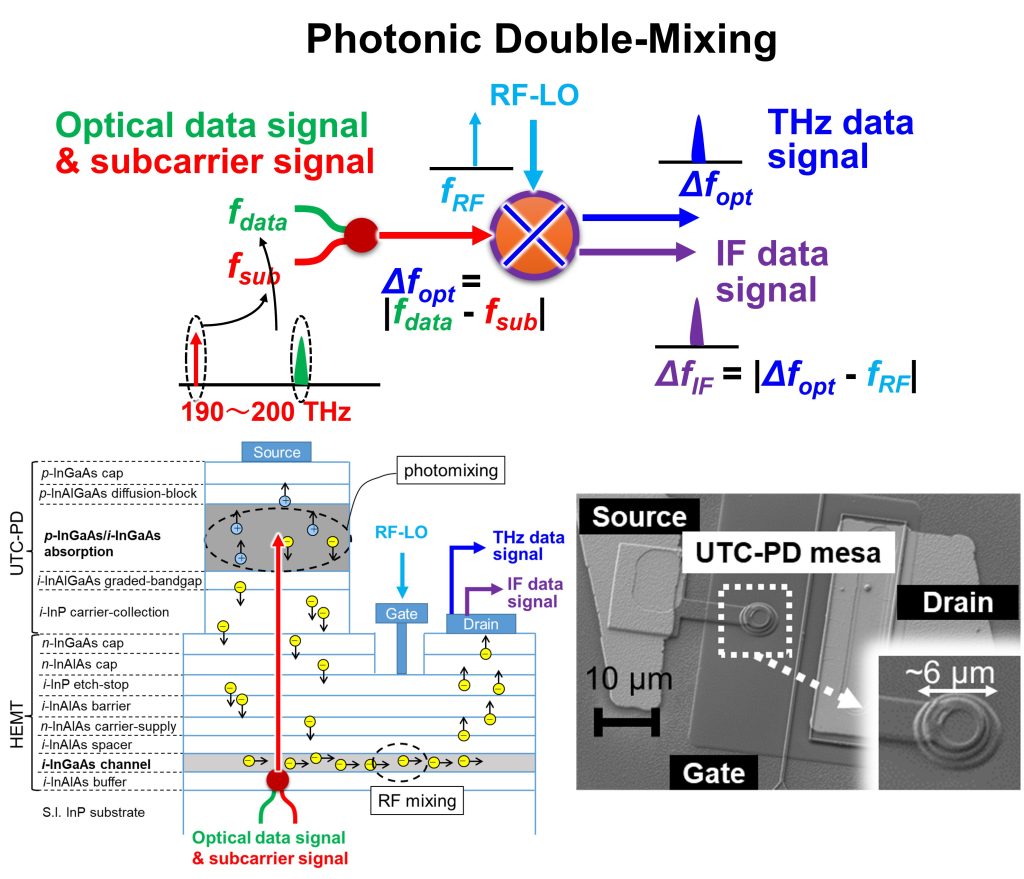
Recently, we have newly proposed and realized a “UTC-PD integrated HEMT,” in which a uni-traveling-carrier photodiode (UTC-PD) is monolithically integrated with an InGaAs-channel high-electron-mobility transistor (HEMT), and have succeeded in dramatically improving the photonic double-mixing conversion efficiency. Furthermore, we have pursued efforts on practical implementation of the devices, including research on UTC-PDs incorporating guided-mode resonance structures to improve optical-to-electrical conversion efficiency, and the development of heterogeneous integration technology for optical-wireless-convergence devices into silicon photonics circuits.
Research Theme #3: Applications of 2D Materials and Topological Insulators to THz/Optical-Wireless-Convergence Devices
To realize high-performance, high-functionality, and high-efficiency devices that surpass existing THz-band devices and optical-wireless-convergence devices, the exploration of new semiconductor materials is essential. In our laboratory, we are conducting research on novel THz devices that utilize heterostructured 2D materials centered on graphene as well as the unique physical properties of topological materials.
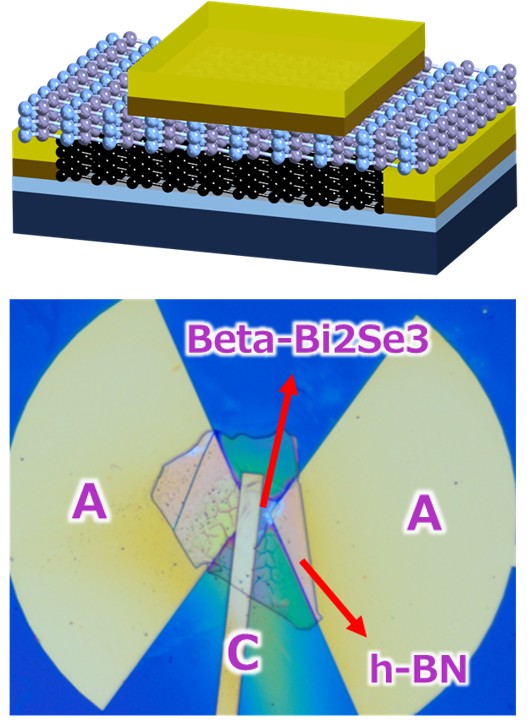
Recently, we fabricated a rectenna diode with Bi2Se3, a topological semimetal, as the active region, and successfully demonstrated bias-free, high-speed THz detection derived from the electron-hole asymmetric Dirac dispersion.
We are also focusing on narrow bandgap 2D materials such as black phosphorus/PtSe2/PtTe2, conducting research to realize new device operating principles through the heterostructures with graphene, and applying them to THz detection devices and optical-wireless-convergence devices.